John Brown Civil War John Brown Civil War Kissing Baby
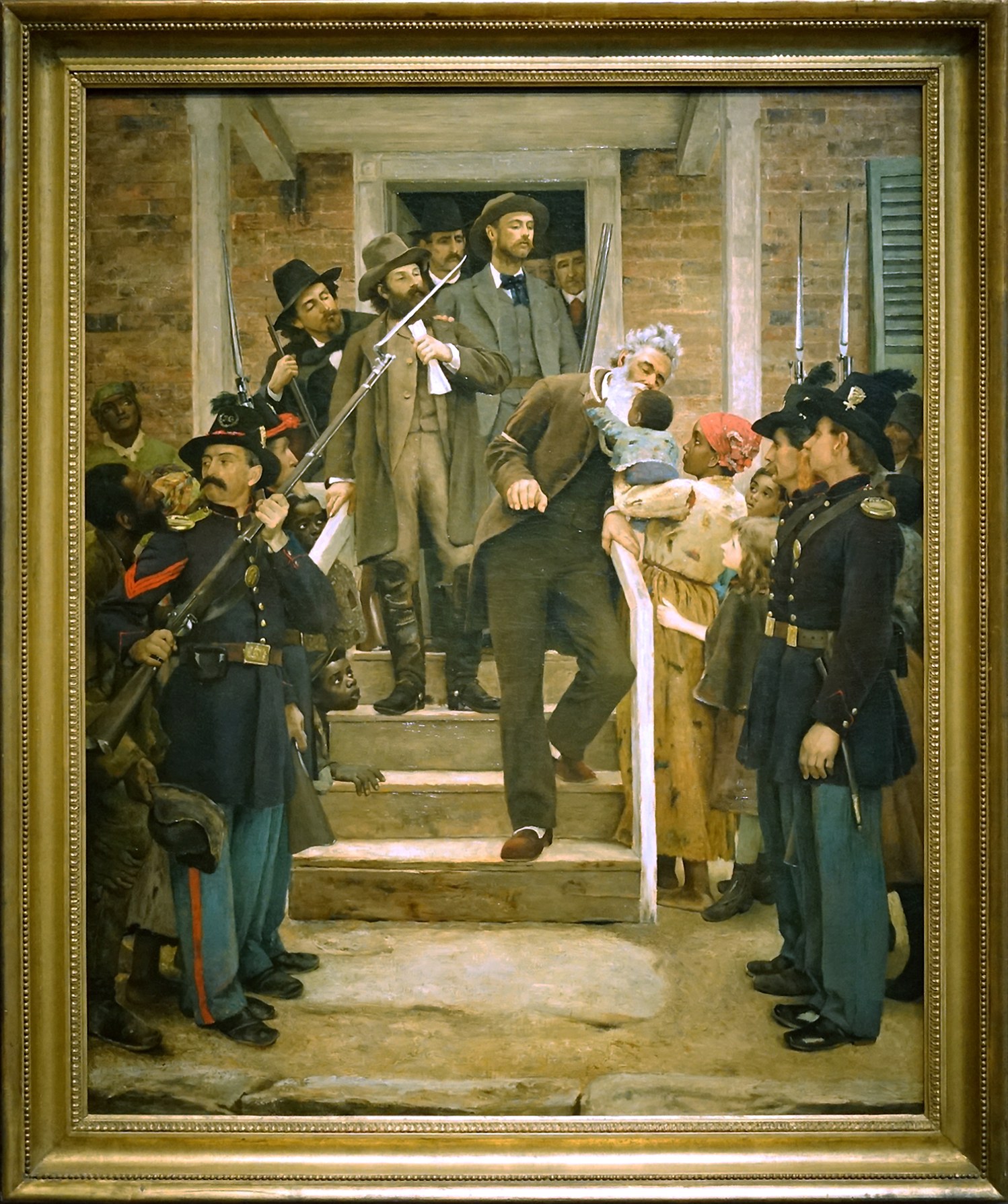
Thomas Hovenden, The Last Moments of John Brown, c. 1884, oil on canvas, 117.2 x 96.8 cm (de Young Museum, Fine Arts Museums of San Francisco; photo: Steven Zucker, CC NY-NC-SA two.0)
"I, John Brown, am at present quite sure that the crimes of this guilty land will never be purged abroad just with blood." —John Chocolate-brown, before long before his execution, 1859
Who was John Chocolate-brown?
Martyr. Murderer. Prophet. Madman. All of these words have been used to depict John Brown, the fiery abolitionist who led vehement attacks against supporters of slavery in the years earlier the U.S. Civil War. A white human being built-in into a securely religious family of Connecticut abolitionists in 1800, Chocolate-brown dedicated his life to a holy war confronting slavery. He scorned the tactic of moral suasion then in faddy among northern abolitionists, believing that only armed uprising could counter the evil of slavery. In 1859, he and a grouping of followers attempted to seize the federal armory at Harpers Ferry, Virginia (now West Virginia) and distribute weapons to enslaved people so they could ascension up against slaveholders. The program failed and Chocolate-brown was captured, tried, and executed amid a media frenzy.
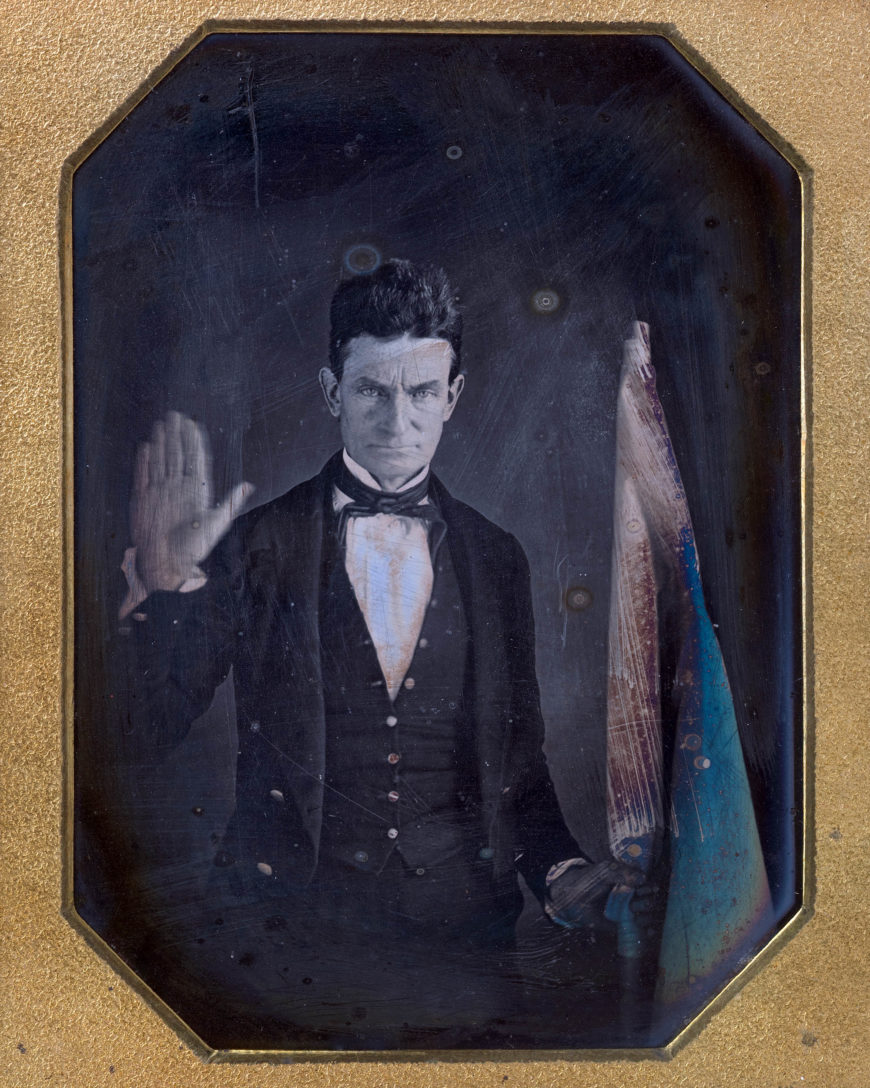
Daguerreotype depicting John Brown c. 1846. Brown was not, at this time, a well known figure, although he was active in abolitionist circles. Here, Brown poses with a determined expect, holding up his left hand (photographic images such as this daguerreotype did not reverse images, then in order to appear that he was holding up his right manus in the finished paradigm he had to hold up his left mitt in reality) equally though he is making an oath. In his right hand, he holds a flag believed to represent the "Subterranean Pass-Mode," a strategic initiative Chocolate-brown envisioned that would transport enslaved people to freedom on a grand scale. The daguerreotypist, Augustus Washington, was an African American lensman with a studio in Hartford, Connecticut. Washington later emigrated to Liberia. Augustus Washington, John Brownish, daguerreotype, 4 1/2 x 7 3/four x 7/sixteen in. (11.iv x 19.vii ten 1.1cm), Hartford, Connecticut (National Portrait Gallery)
From some perspectives, Dark-brown could be considered a failure: his plan to bring virtually a massive uprising of enslaved people never came to fruition, and he was hanged for treason years before the Thirteenth Subpoena outlawed slavery. But from other perspectives, Brown succeeded beyond his wildest dreams: his execution elevated him to the level of an abolitionist martyr, garnering sympathy for the crusade he was willing to die for. His actions contributed to such paranoia among slaveholders most the future of slavery in the United States that slave states seceded when anti-slavery candidate Abraham Lincoln was elected president, putting in motion the events that ultimately would pb to slavery's downfall.
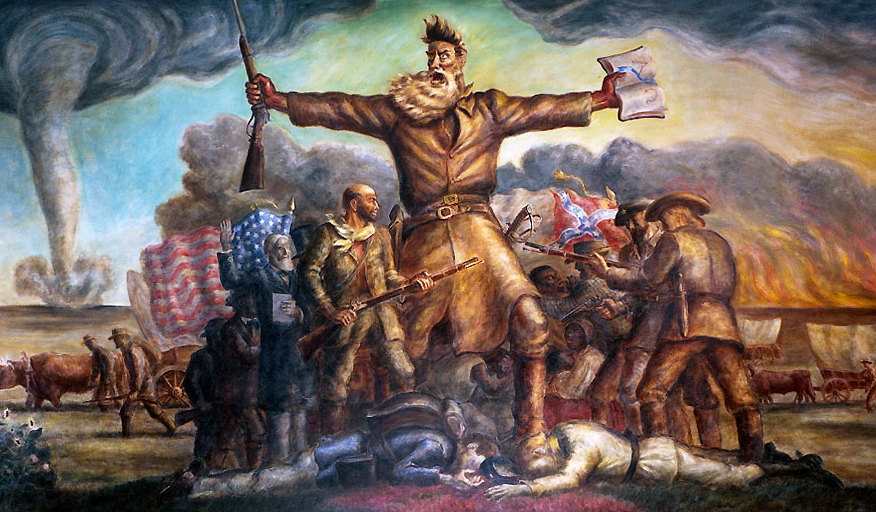
John Steuart Back-scratch, Tragic Prelude (particular), 1937–42, oil and egg tempera 11′ 6″ ten 31 feet (Kansas statehouse, Topeka) This landscape, in the Kansas Country Capitol edifice, depicts John Brown every bit a fanatic, Moses-like effigy, striding forward every bit clouds office in the sky (not unlike the parting of the Reddish Sea), in a composition reminiscent of Delacroix's Liberty Leading the People. He holds a rifle (the so-called "Beecher'southward Bible" rifle sent to abolitionists fighting in the Kansas Territory) and an actual Bible featuring the Greek letters alpha and omega (a reference to Christ in the Volume of Revelation, describing the Apocalypse). In the distance, covered wagons motility right to left (westward). Backside Chocolate-brown are figures belongings the flag of the United States and the battle flag of the Confederacy. In the foreground, men wearing the uniforms of soldiers on each side of the Ceremonious State of war lay dead at Brown's feet. Beside his left knee nosotros tin make out soldiers violently assaulting a Black family unit. Curry depicts John Brown'due south office in Haemorrhage Kansas as a "tragic prelude" to the Civil War, with tornadoes and prairie fires in the groundwork representing the coming destruction. Curry did not revere Dark-brown, describing him equally a "bloodythirsty, god-fearing maniac." [ane]
The growing sectional divide of the 1850s
In the first half of the 19th century, the U.Due south. authorities worked to maintain the balance of political power between free and slave states by ensuring that their numbers remained equal. Merely, equally the country expanded west to territories across the Mississippi River, with American settlers displacing the Ethnic inhabitants and forming new states, that balance began to falter. Several events in the 1850s contributed to a growing belief among anti-slavery activists that the "Slave Ability," every bit they called it, had gained control of the U.S. regime: the introduction of a brutal Fugitive Slave Law (1850) required northern citizens to help in the capture of enslaved people who had escaped; the Kansas-Nebraska Deed (1854) repealed an before ban on slavery in new territories due north of the Missouri Compromise line; and the Supreme Court conclusion in Dred Scott v. Sanford (1857) ruled that Blackness Americans were not U.Southward. citizens.
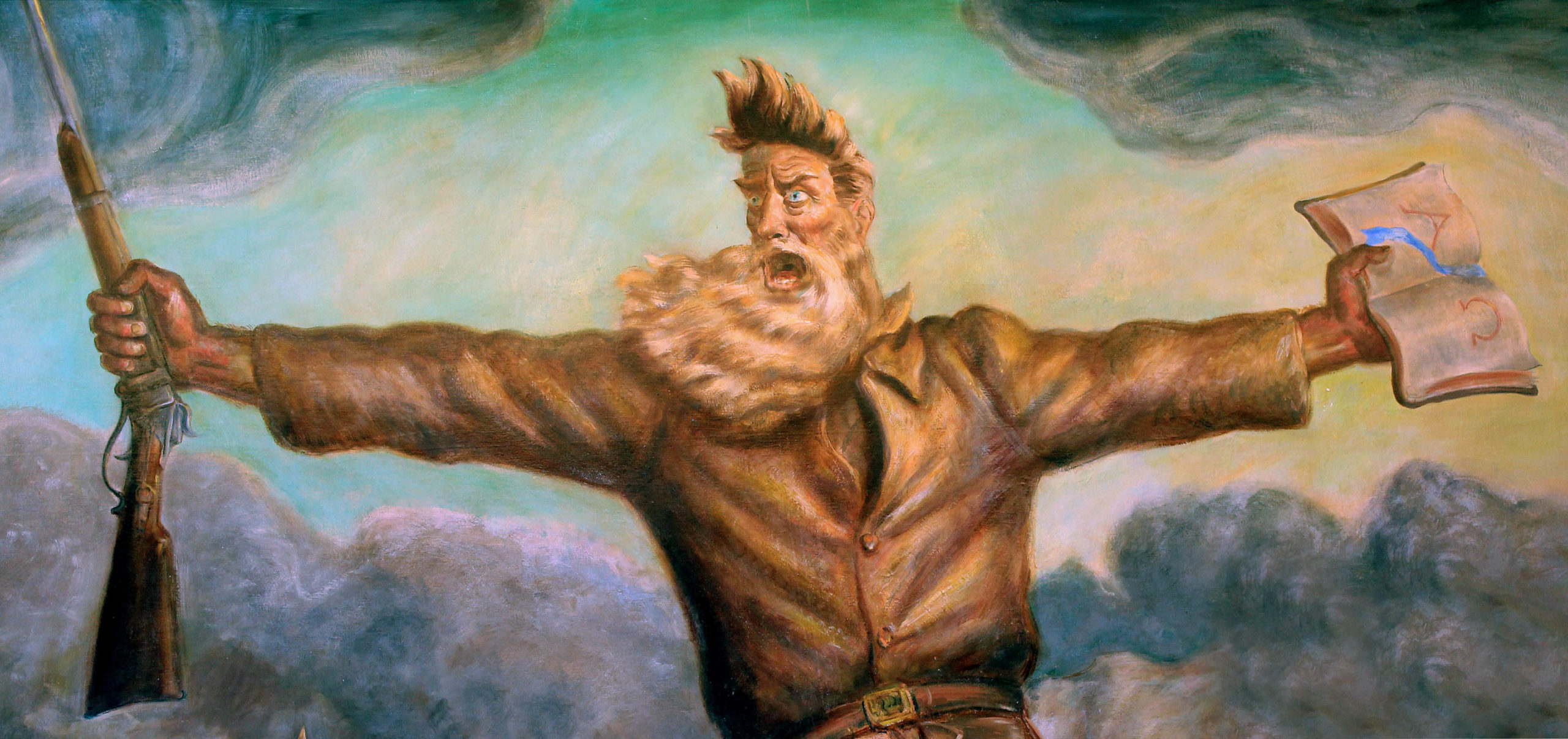
Detail, John Steuart Curry, Tragic Prelude , 1937–42, oil and egg tempera 11′ 6″ x 31 feet (Kansas statehouse, Topeka)
John Brownish first became a nationally known figure in 1856 through his actions in the Kansas Territory, three years before the raid on Harpers Ferry. Kansas was and then the site of a territorial ceremonious war known as Bleeding Kansas, the result of the Kansas-Nebraska Act's provision assuasive the residents of the territory to vote on whether to allow slavery. Pro- and anti-slavery settlers attempting to sway the vote flooded the region, and quickly came to blows. Amid the ranks of "Gratuitous-Staters" were John Brown and five of his sons, who had come to Kansas to take up artillery in defense of abolitionism.
In May 1856, Brown led his sons and 3 other men in what came to be known as the Pottawatomie Massacre, a three-day binge during which they murdered five members of the pro-slavery territorial district court in forepart of their families, hacking them to decease with broadswords. Brown was enraged by ii recent attacks on abolitionists past pro-slavery forces—the trigger-happy assail on the town of Lawrence, Kansas, and so an abolitionist eye , and the caning of abolitionist Charles Sumner on the Senate floor.The Pottawatomie Massacre escalated the violence in Kansas to a fever pitch, drawing federal troops to the territory. Brownish and his allies engaged in battle with pro-slavery forces throughout the summer of 1856, becoming a ruthless leader whom southern slaveholders feared and northern abolitionists admired.
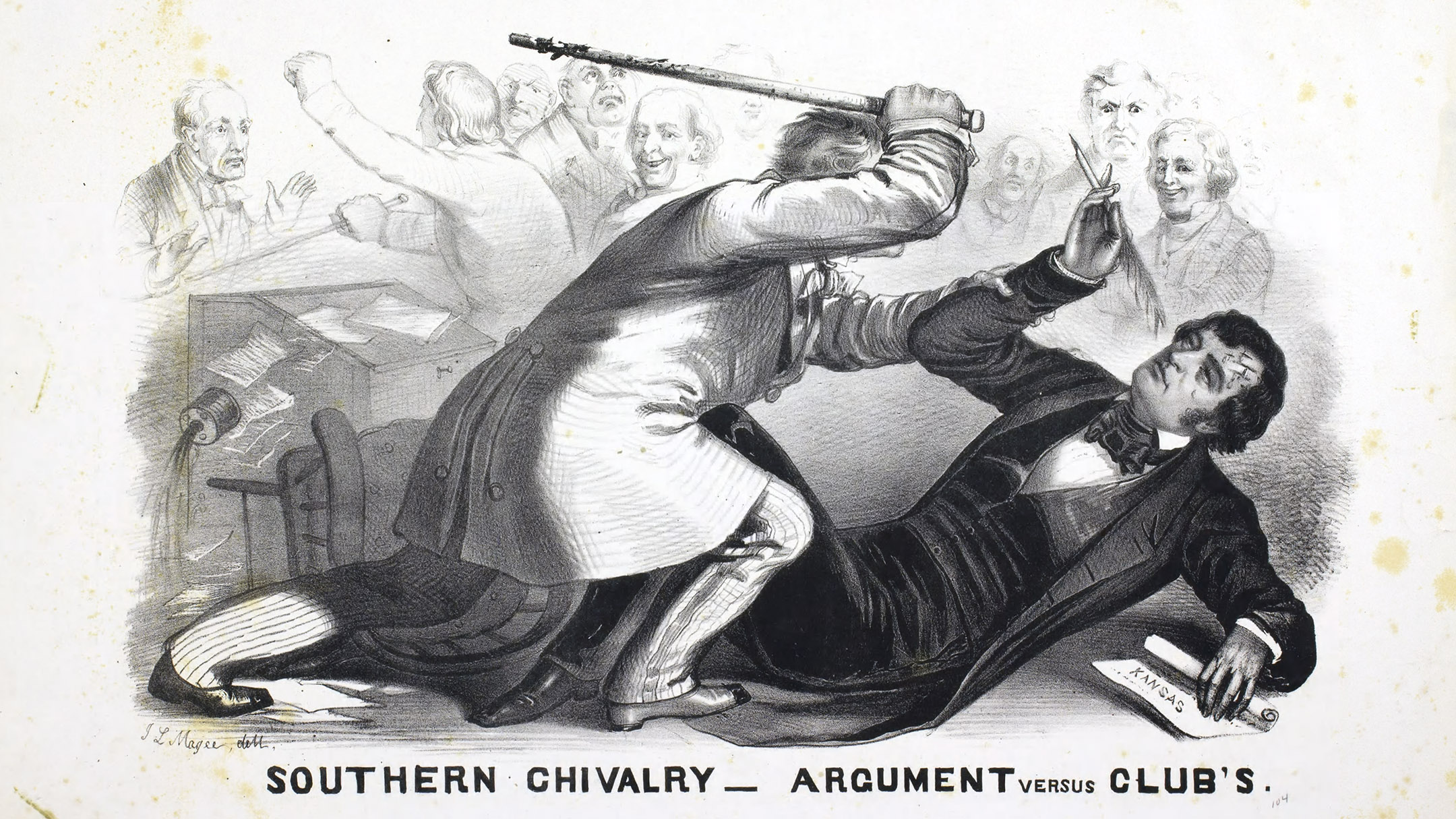
This political drawing depicts the pro-slavery congressman Preston Brooks attacking the anti-slavery Senator Charles Sumner with a cane on the Senate flooring. The title, "Southern Chivalry — argument versus lodge'southward" ironically mocks this set on equally "southern knightly" since Sumner had criticized Brooks'south uncle as a lover of slavery in a recent speech (the "Crime Against Kansas" speech, which Sumner holds in his left hand). Here, Sumner is depicted bleeding, pen in mitt, with a dignified expression while Brooks (whose face is blocked by his arm) raises a mangled cane to strike him again. John Brown was enraged past the attack on Sumner, which motivated his actions at Pottawatomie. John Fifty. Magee, Southern chivalry – argument versus club'due south, 1856, lithograph, 13.23 10 nineteen in. (The Library Company of Philadelphia)
The raid at Harpers Ferry
Although he was under indictment for the Pottawatomie murders, Brown managed to evade capture and make his way to the northeast, where he was received enthusiastically by abolitionists. Brown had long cherished the idea of leading a large-calibration rebellion of enslaved people, similar the Haitian Revolution or Nat Turner's rebellion, and he spent several years traveling through New England and Canada, raising coin, gathering weapons, and preparing for battle.
Brown somewhen determined that he would lead a team of men to the federal armory at Harpers Ferry, Virginia, distributing its weapons as he marched south to liberate enslaved Blackness people from plantations. Harpers Ferry was a strategic location not only because of its firearms cache but also for its position every bit a major rail and river junction (railroads and rivers were then the easiest ways to send people and goods long distances). Brown believed that he would grow an ever larger regular army every bit the freed people joined him. He consulted with notable Black abolitionists about his plan, including Frederick Douglass—who counseled him against the action—and Harriet Tubman, who helped him recruit participants.
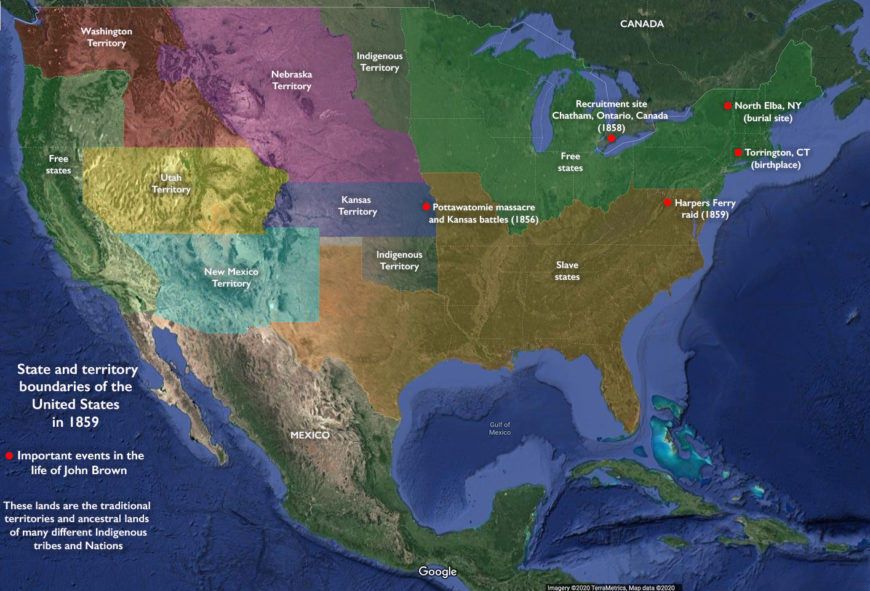
Map depicting U.S. state and territory boundaries in 1859, featuring the location of important events in the life of John Brown (underlying map © Google)
In October 1859, Brownish and a grouping of xx-1 Black and white men captured the armory and took hostages, alerting the enslaved residents nearby of their programme. However, most of the enslaved people about Harpers Ferry were loath to trust an unknown white homo, and to Brown's surprise, the massive uprising that he had predicted failed to materialize. A train usher raised the warning, local militias pinned Brown and his men inside the armory, and by the following twenty-four hour period U.Southward. Marines under the command of Robert E. Lee (the future Amalgamated general) arrived and demanded their surrender. Brown refused, and the Marines stormed the armory, wounded Chocolate-brown, and took him and his 7 remaining men (the others had died or escaped) prisoner.
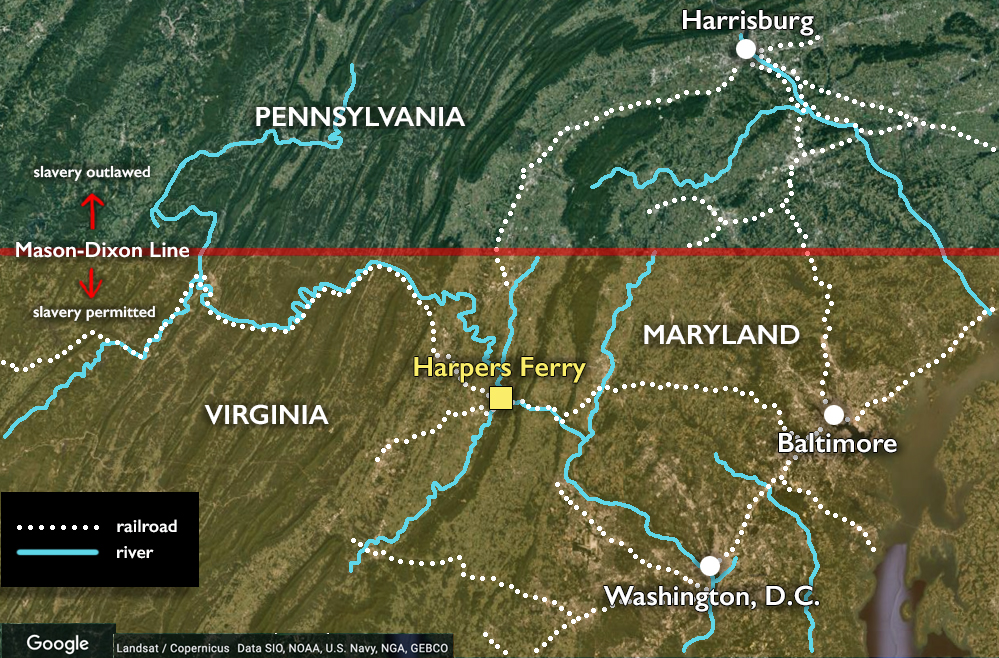
Map depicting Harpers Ferry, a strategic location at the junction of railroads and rivers. Although Harpers Ferry was located in the slave state of Virginia, it was quite shut to the complimentary country of Pennsylvania (underlying map © Google)
The subsequent trial of Brownish and his men for murder, inciting slave rebellion, and treason was widely reported in the national press. His speech upon confidence, in which he proclaimed that " if it is deemed necessary that I should forfeit my life for the furtherance of the ends of justice, and mingle my blood farther with the blood of my children and with the claret of millions in this slave country whose rights are disregarded by wicked, cruel, and unjust enactments, I submit; then allow it be done!" was printed in 50 newspapers, including on the front page of The New York Times .
John Brown was hanged on December two, 1859. The story that he paused to kiss a Black infant on his fashion to the gallows was starting time circulated by Brown'south friend and supporter, journalist James Redpath, in a biography published just months later the execution to enhance money for Brownish'due south widow and children.
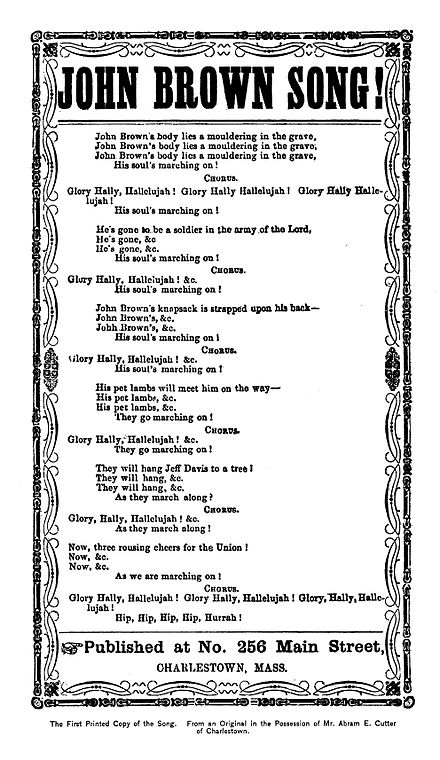
Songsheet featuring the lyrics of the "John Dark-brown Vocal," later called "John Brown's Body." Julia Ward Howe wrote new lyrics for the melody, producing "The Battle Hymn of the Republic," which became the anthem of U.S. forces during the Ceremonious War. James Due east. Greenleaf, et. al., "John Brown Song!", 1861.
John Brown in American memory
Although abolitionists praised Chocolate-brown, many Republican politicians—including Abraham Lincoln—sought to distance themselves from him. [2] But once the Civil War was underway, Chocolate-brown's courageous fight against slavery took on new resonance. The song "John Brown's Body," a Ceremonious State of war marching song, provided the inspiration for "The Battle Hymn of the Republic."
Brownish'southward circuitous legacy has been viewed in different lights in the century and a one-half since his death. Frederick Douglass, who had to flee to England to escape possible retribution for his knowledge of Brown'southward plans, later gave a voice communication praising him, maxim that "If John Brown did not end the war that ended slavery, he did at least begin the state of war that ended slavery." [3] During the Jim Crow era, when mainstream American memory of the Ceremonious War downplayed the importance of emancipation, many white historians portrayed Brownish every bit a zealot and a madman, although Blackness intellectuals and artists, like W.E.B. DuBois and Jacob Lawrence, portrayed him sympathetically. Controversy over John Brown's deportment, and whether information technology's acceptable to utilise violence to claiming social injustice, remains with us today.
Notes:
- Quoted in R. Blakeslee Gilpin, John Brown Nonetheless Lives!: America'southward Long Reckoning with Violence, Equality, & Change (UNC Press, 2011), 154.
- Lincoln denied that Republicans supported Brown in his spoken communication at Cooper Union in New York City on February 27, 1860: "Y'all accuse that we stir up insurrections among your slaves. We deny it; and what is your proof? Harpers Ferry! John Brown! John Chocolate-brown was no Republican; and you have failed to implicate a unmarried Republican in his Harper's Ferry enterprise."
- Frederick Douglass, "John Dark-brown: An Accost," Harpers Ferry, Due west Virginia, May 30, 1881.
Additional resources:
Read nearly Augustus Washington's daguerreotype of John Chocolate-brown in Smithsonian Mag
Run across Jacob Lawrence's Legend of John Brown series at the Detroit Art Institute
Acquire about John Dark-brown's "Holy State of war" from the American Feel on PBS
Hear the evolution of the John Dark-brown vocal at Teachinghistory.org
Source: https://smarthistory.org/john-browns-tragic-prelude-to-the-u-s-civil-war/
0 Response to "John Brown Civil War John Brown Civil War Kissing Baby"
Publicar un comentario